Plaça Sant Jaume
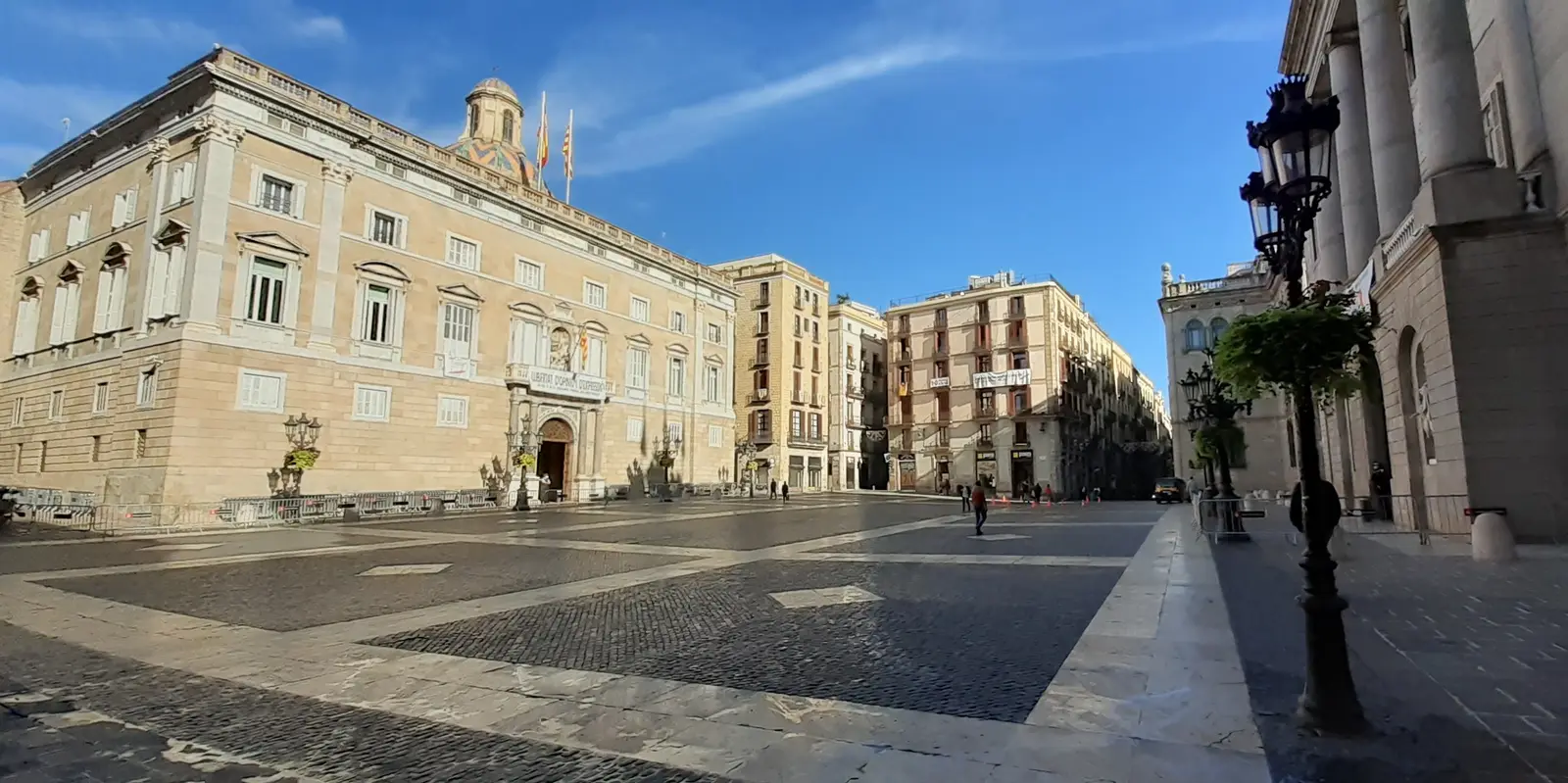
Photo: Herodotptlomeu on Wikipedia
- Category
- Monument
- Hours
- Open access 24 hours; the institutional buildings only open to the public on specific dates
- Price
- Free to walk around; visits to the Ajuntament and Generalitat are free on open-house days
- Neighborhood
- Ciutat Vella
- How to get there
- Metro L4, Jaume I stop, or L3, Liceu stop
This square occupies, almost without moving, the same spot where the forum of Roman Barcino stood two thousand years ago: the crossing of the founding city's two main roads. Since then it has never stopped being Barcelona's administrative centre, making it one of the squares with the longest continuous institutional use in Europe.
On one side, the Ajuntament (the Casa de la Ciutat), with a 19th-century neoclassical façade that hides a 14th-century Gothic Saló de Cent inside. Opposite, the Palau de la Generalitat de Catalunya, seat of the Catalan government, with a Gothic courtyard of its own. Neither can be visited freely on any given day, but both open for free on notable occasions, such as Sant Jordi (23 April) or European Heritage Days.
It's also the usual stage for celebrations and mass gatherings: this is where castells (human towers) are built during festivals like La Mercè, and where crowds gather when Barça wins something important. If your visit coincides with a castells day, it's worth stopping to watch — no ticket or booking needed.
Frequently asked questions
Can you visit the inside of the Ajuntament or the Generalitat?
Only on notable occasions, such as Sant Jordi (23 April) or European Heritage Days, and free of charge.
What are the castells you see at Plaça Sant Jaume?
Human towers built during festivals like La Mercè; no ticket or booking is needed to watch them.